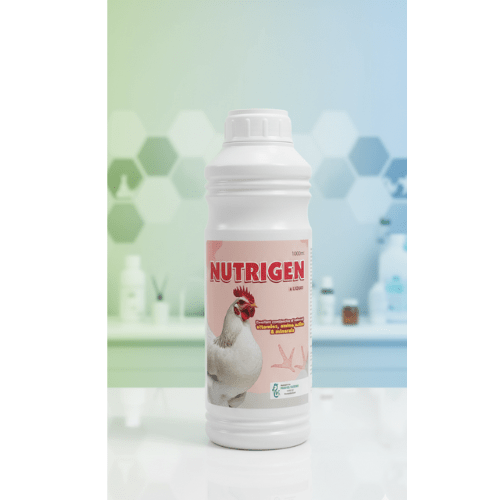
Featured Product: NUTRIGEN LIQUID
Vaccination stress and post-disease recovery both deplete a flock’s vitamin reserves. NUTRIGEN LIQUID replenishes vitamins A, D3, E, K, B-complex and key electrolytes, improving immune response to Newcastle Disease vaccines and supporting faster flock recovery. Give 2–3 days before and after each vaccination.
Newcastle Disease (ND) — locally known in Pakistan as Ranikhet Disease — is the single most feared poultry disease in the country. Caused by Avian Paramyxovirus Type 1 (APMV-1), highly virulent velogenic strains can kill an entire unvaccinated flock within 3–5 days. Even with vaccination, circulating virulent field strains cause repeated production losses across broiler and layer operations nationwide.
Understanding ND virology, designing the right vaccination programme, and knowing how to respond to a breakthrough outbreak is essential knowledge for every Pakistani poultry farmer and farm manager. This guide from Poulive Trading‘s veterinary team covers everything you need to know.
Understanding Newcastle Disease Virus Pathotypes
APMV-1 strains are classified by virulence using the Intracerebral Pathogenicity Index (ICPI) test:
- Lentogenic strains (ICPI < 0.7): Mild or inapparent — used as live vaccines (La Sota, Clone 30, Hitchner B1)
- Mesogenic strains (ICPI 0.7–1.5): Moderate virulence — respiratory and reproductive signs, moderate mortality
- Velogenic strains (ICPI > 1.5): Highly virulent — viscerotropic (haemorrhagic gut lesions) or neurotropic forms — catastrophic mortality up to 100%
In Pakistan, velogenic viscerotropic Newcastle disease (VVND) is endemic, particularly in Punjab and KPK. A constant, well-timed vaccination programme is the only effective defence.
Clinical Signs by Pathotype
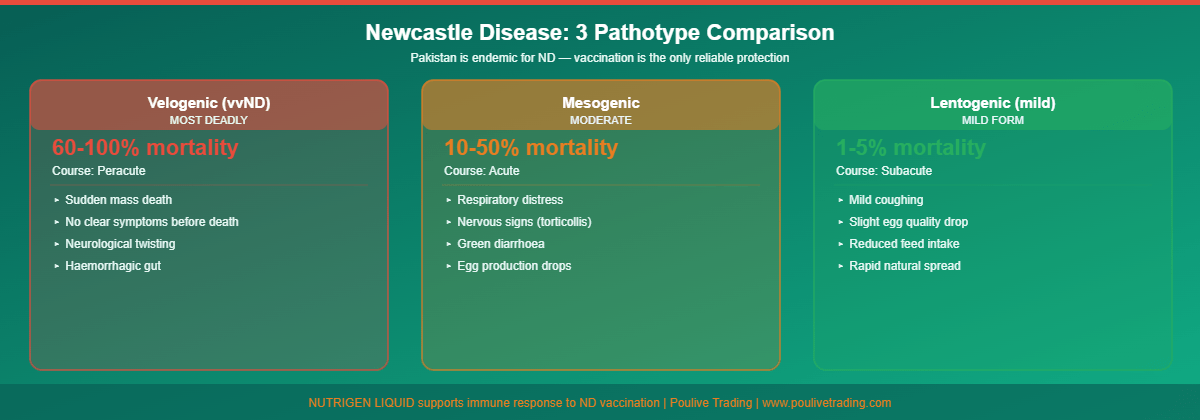
Velogenic (VVND) — The Deadliest Form
- Sudden, very high mortality (up to 100% in fully susceptible flocks within 3–5 days)
- Characteristic green watery diarrhoea
- Severe respiratory distress — gasping, wheezing, nasal discharge
- Neurological signs: torticollis (twisted neck), circling, wing drooping, paralysis
- Oedema of head and wattles
- Complete cessation of egg production within 24–48 hours
Mesogenic — Moderate Form
- Respiratory signs — coughing, sneezing, tracheal rales
- Significant egg drop with soft-shelled and deformed eggs
- Transient neurological signs in some birds
- Moderate mortality (5–20%) in partially immune flocks
Newcastle Disease Vaccination Programme for Pakistan
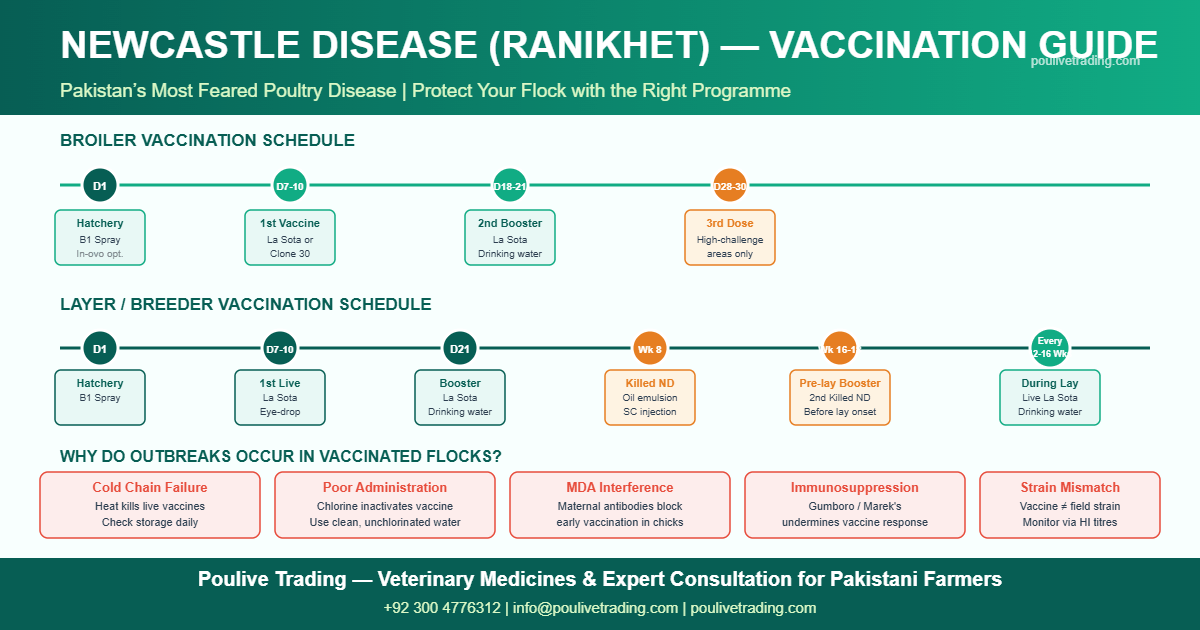
Broiler Vaccination Schedule
- Day 1 (hatchery): Hitchner B1 — coarse spray or in-ovo
- Day 7–10: La Sota or Clone 30 — eye-drop (most effective) or drinking water
- Day 18–21: Second La Sota booster (essential in high-challenge areas)
- Day 28–30 (if marketing at 42+ days): Third booster in velogenic-endemic regions
Layer Vaccination Schedule
- Day 1: B1 spray at hatchery
- Day 7–10: La Sota eye-drop
- Day 21: La Sota booster via drinking water
- Week 8: Killed ND oil-emulsion vaccine — subcutaneous injection
- Week 16–18: Second killed ND vaccine before onset of lay
- Every 12–16 weeks during lay: Live La Sota booster via drinking water
Vaccine titre monitoring is the best investment a Pakistani poultry farmer can make. An HI titre below log₂ 3 in broilers or below log₂ 4 in layers before peak production is a red flag for an imminent outbreak.
Poulive Trading Veterinary Advisory Team
Why Do Outbreaks Occur in Vaccinated Flocks?
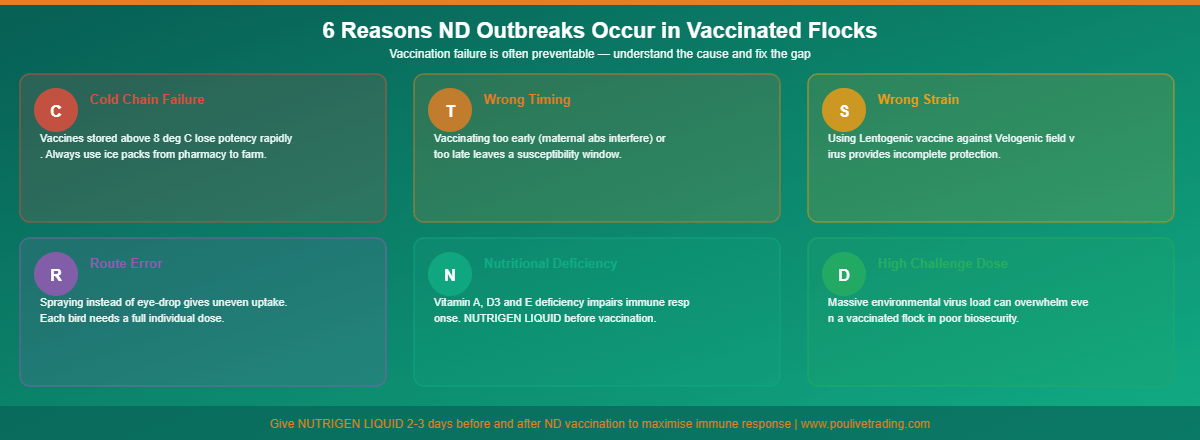
- Cold chain failure: Live ND vaccines are heat-sensitive — even brief temperature breaks render them inactive
- Poor administration: Diluted vaccine not reaching all birds; chlorinated water inactivating live vaccine
- High maternal antibody interference: MDA from breeders blocks vaccination in very young chicks
- Immunosuppression from Gumboro disease, Marek’s disease, or mycotoxins
- Antigenic mismatch: Vaccine strains not matching circulating velogenic genotypes in Pakistan
- Extremely high field challenge overwhelming even well-vaccinated immunity
Managing a Suspected Newcastle Disease Outbreak
- Immediately isolate the affected house — halt all personnel and equipment movement between houses
- Contact your regional Livestock and Dairy Development Department (LDD) immediately — ND is notifiable
- Provide electrolytes and multivitamins in drinking water for surviving birds (NUTRIGEN LIQUID)
- Apply broad-spectrum antibiotics under veterinary prescription to control secondary bacterial pneumonia
- Consider emergency live ND vaccination of unaffected adjacent flocks
- Prepare for thorough terminal disinfection after depopulation
Post-Outbreak Restocking Protocol
- Complete dry cleanout — remove all litter, dead birds, feed residues
- High-pressure wash all surfaces followed by approved disinfection protocol
- Fumigate sealed house with formalin for 12 hours minimum
- Minimum 14-day downtime before restocking
- Source new chicks with documented, current MDA ND titres from the hatchery
- Consider serology monitoring on the first new flock to confirm vaccination is working
Economic Cost of Newcastle Disease in Pakistan
Pakistan’s poultry industry generates over PKR 2 trillion annually. A single VVND outbreak on a 100,000-bird layer farm can result in losses exceeding PKR 20–30 million through direct mortality, egg production losses, medication costs, and restocking delays. Prevention through proper vaccination is exponentially cheaper than managing an outbreak.
Poulive Trading stocks veterinary medicines for Newcastle disease outbreak support and recovery. Contact our team for immediate consultation: +92 300 4776312 | info@poulivetrading.com
Disclaimer: Vaccination schedules must be designed by a qualified poultry veterinarian based on local disease pressure, flock history, and maternal antibody monitoring results.