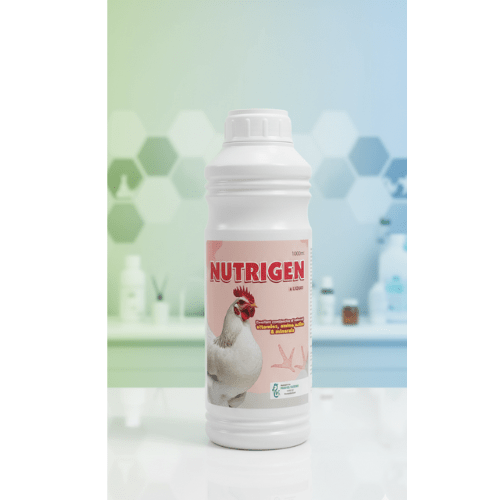
Featured Product: NUTRIGEN LIQUID
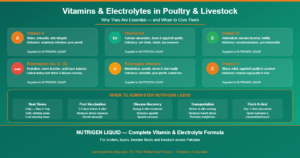
During and after a coccidiosis outbreak, birds suffer from intestinal bleeding, anaemia and severe nutritional depletion. NUTRIGEN LIQUID provides vitamins K (anti-haemorrhagic), A (gut repair), E and B-complex to support recovery and restore flock performance quickly alongside coccidiosis treatment.
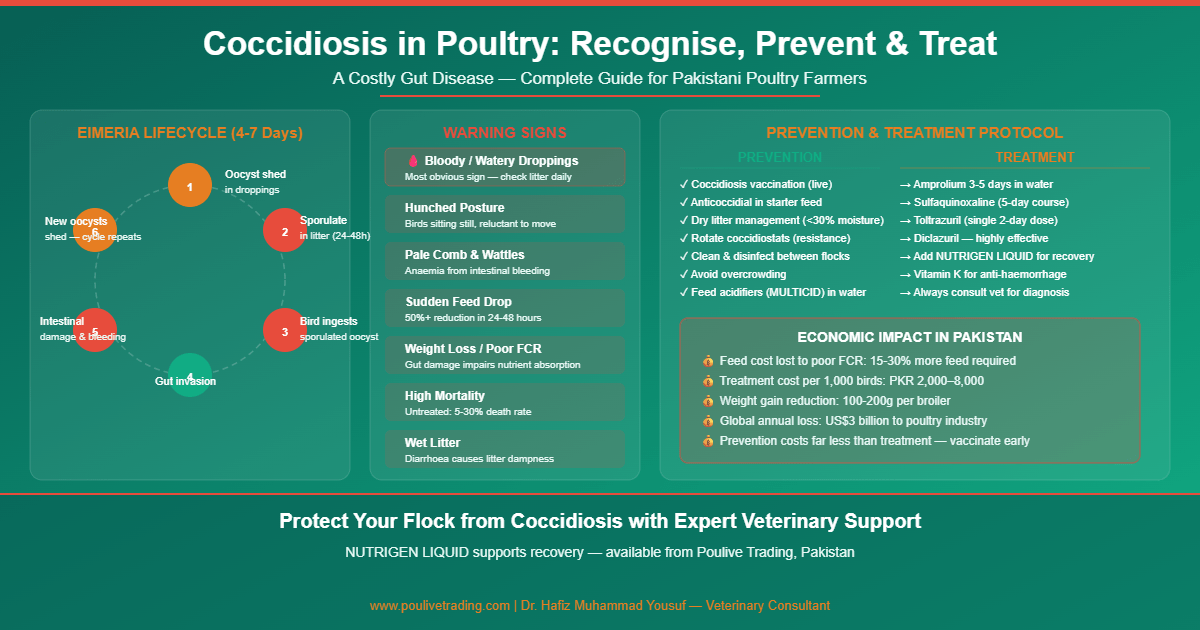
Coccidiosis is one of the most common and costly intestinal diseases affecting Pakistani poultry farms. Caused by single-celled parasites of the genus Eimeria, coccidiosis destroys the gut lining, causes bloody diarrhoea, reduces nutrient absorption, and creates the perfect environment for secondary bacterial infections — particularly Clostridium perfringens (Necrotic Enteritis). In severe outbreaks, mortality can reach 20–30% in unprotected flocks.
What makes coccidiosis especially insidious is that subclinical disease — where birds show no obvious signs but intestinal damage is silently reducing weight gain and feed efficiency — probably costs Pakistani farmers far more than clinical outbreaks ever do.
What Is Coccidiosis?
Coccidiosis is caused by protozoan parasites (Eimeria spp.) that invade and destroy specific sections of the intestinal tract. In chickens, seven species are clinically important:
- E. tenella: Caecal coccidiosis — the most severe, causing bloody droppings and high mortality
- E. necatrix: Mid-intestinal haemorrhage and high mortality in older birds
- E. acervulina: Duodenal — most common; causes poor absorption but low mortality; large economic impact
- E. maxima: Mid-small intestine — reduces carotenoid absorption, causing pale egg yolks
- E. brunetti: Lower small intestine and rectum
- E. mitis: Distal small intestine — often subclinical
- E. praecox: Duodenum — usually subclinical but contributes to performance loss
The life cycle of Eimeria occurs within the host and the immediate environment. Oocysts (infective eggs) shed in faeces sporulate in litter under warm, humid conditions within 24–48 hours and are ingested by birds through contaminated feed and water. The internal cycle then destroys intestinal epithelial cells as the parasite multiplies.
Clinical Signs of Coccidiosis
Acute Clinical Coccidiosis
- Bloody diarrhoea — dark red or coffee-coloured droppings (E. tenella caecal coccidiosis)
- Watery, mucoid, or orange-coloured diarrhoea (intestinal forms)
- Ruffled feathers; birds huddle near heat sources
- Pale combs and wattles (anaemia from blood loss)
- Sudden drop in feed and water intake
- Mortality spiking from Day 5–6 post-infection
Subclinical Coccidiosis
- Poorer-than-expected feed conversion ratio (FCR)
- Reduced average daily weight gain
- High variation in body weight — poor flock uniformity (CV >10%)
- Wet litter from increased water intake due to gut malabsorption
- Increased susceptibility to Necrotic Enteritis — gut damage enables C. perfringens overgrowth
Diagnosis
- Clinical signs and post-mortem: Intestinal lesions scored using the Johnson-Reid scoring system (0–4)
- Oocyst count in faeces or litter: Floatation technique — high oocyst output confirms exposure
- Species identification: Important for choosing the right coccidiostat or vaccine — requires specialist microscopy or PCR
Prevention Strategies
Coccidiostats in Feed
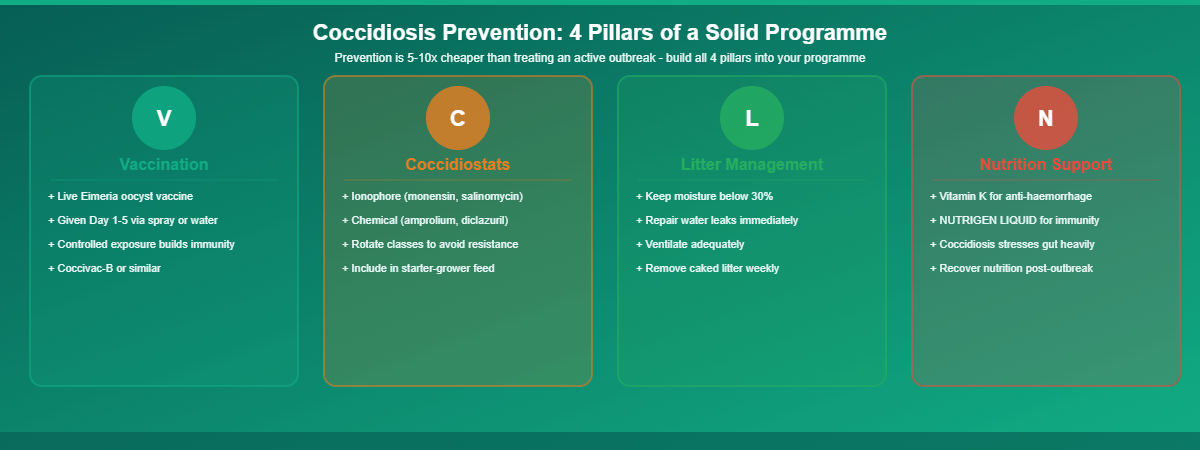
Coccidiostats are feed additives that prevent or kill Eimeria at various life cycle stages. Commonly used classes in Pakistan:
- Ionophores (monensin, salinomycin, maduramicin): Broad-spectrum, coccidiostatic — allow gradual immunity development; note strict incompatibility with tiamulin (must observe withdrawal)
- Chemical coccidiostats (diclazuril, toltrazuril): Used for shuttle and rotation programmes and acute therapeutic treatment
- Shuttle programmes: Starting on ionophore, switching to chemical at mid-grow-out — helps delay resistance development on farms that have used the same product for years
Rotation and shuttle coccidiostat programmes — alternating between ionophore and chemical classes — are increasingly important on Pakistani farms where resistance to single-product programmes has built up over decades of continuous use.
Poulive Trading Veterinary Advisory Team
Litter Management for Coccidiosis Prevention
- Maintain litter moisture below 25–30% — wet litter dramatically accelerates oocyst sporulation
- Use acidified litter treatments to reduce oocyst viability in problem areas
- Top-dress wet spots with fresh, dry wood shavings or rice hulls
- Ensure adequate ventilation — the single most important factor for litter dryness
Treatment of Acute Coccidiosis Outbreaks
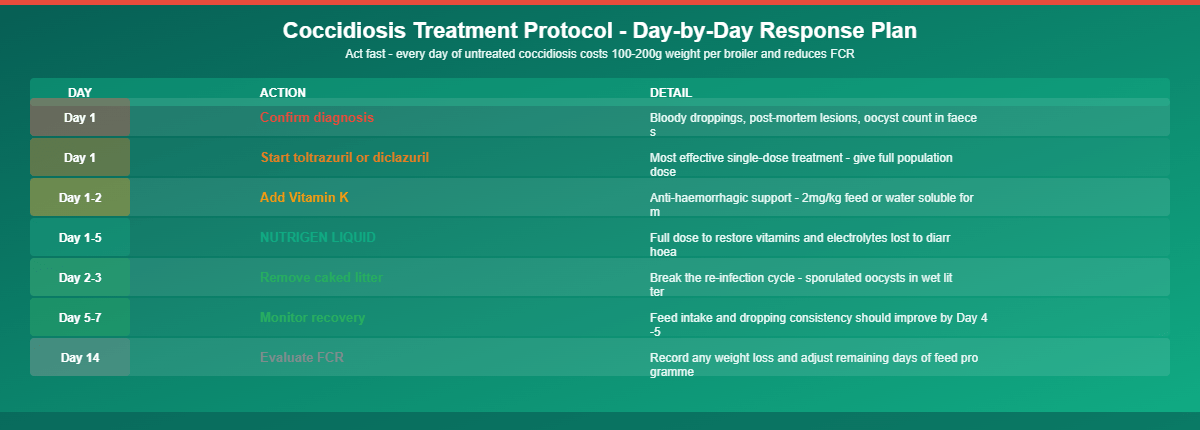
- Toltrazuril or diclazuril via drinking water: 2 consecutive days — highly effective against all Eimeria species
- Vitamin K supplementation: Stops intestinal haemorrhage in E. tenella and E. necatrix infections
- Electrolytes and multivitamins: Combat dehydration and anaemia — NUTRIGEN LIQUID from Poulive Trading is ideal
- Antibiotic for secondary Necrotic Enteritis: Amoxicillin or lincomycin if C. perfringens co-infection is suspected — always under veterinary prescription
The Economic Cost of Coccidiosis to Pakistani Poultry Farmers
Studies estimate coccidiosis costs the global poultry industry over USD 3 billion annually. On a Pakistani broiler farm, subclinical coccidiosis alone can reduce weight gain by 50–100 g per bird and increase FCR by 0.1–0.3 points. When Necrotic Enteritis follows, losses multiply further. A farm that successfully eliminates coccidiosis as a limiting factor can improve margins by PKR 3–5 per bird — significant at commercial scale.
Need help diagnosing intestinal disease or designing a coccidiosis management programme for your farm? Poulive Trading’s veterinary team is here to help. Call +92 300 4776312.
Disclaimer: Treatment with registered veterinary medicines should be done under veterinary supervision. Withdrawal periods must be respected for all products used in meat and egg production.