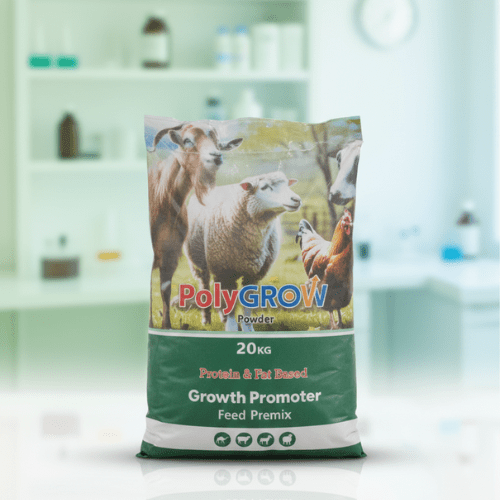
Featured Product: PolyGROW Powder
PolyGROW Powder provides the concentrated protein and energy that laying hens need to sustain peak production. Its balanced amino acid profile supports egg mass, shell quality and body weight maintenance throughout the laying cycle.
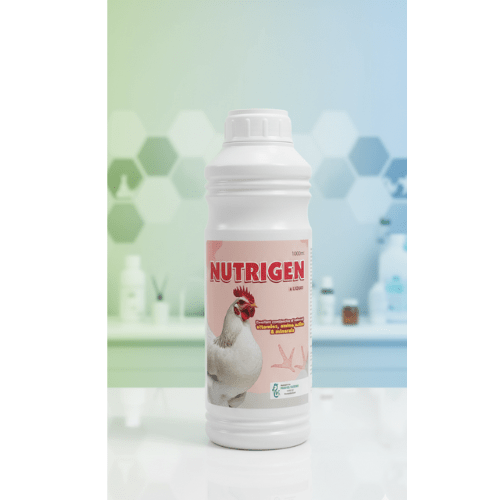
Featured Product: NUTRIGEN LIQUID
NUTRIGEN LIQUID is essential during the laying cycle — it supplies vitamin D3 for calcium absorption (critical for shell quality), vitamin E for reproductive health and electrolytes to offset heat stress in Pakistan’s summer months.
Pakistan produces over 20 billion eggs annually, making layer farming one of the most important segments of the country’s poultry industry. Yet many Pakistani layer farmers consistently achieve only 80–85% of the genetic production potential their hens are capable of delivering. That gap between actual and achievable production is where profitability is lost.
Whether you manage a small family layer unit or a large commercial farm, the principles for maximising egg production are the same. In this guide, Poulive Trading‘s veterinary team shares expert strategies to help you push your flock to its genetic potential.
Understanding the Egg Production Cycle
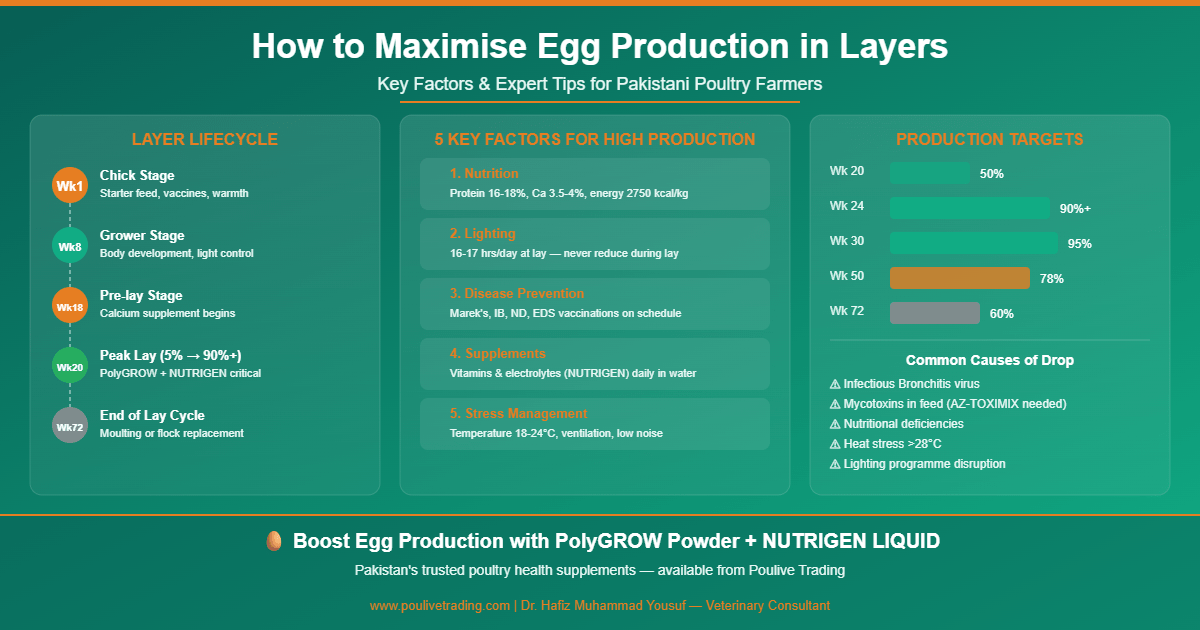
A commercial hybrid layer (e.g., Hy-Line Brown, Lohmann Brown) is genetically capable of producing 300–330 eggs per hen housed in a 52-week laying period:
- Onset of lay: Week 17–19 (pullets should weigh ≥1.5 kg at 16 weeks)
- Peak production: Weeks 26–30 — target 94–96% hen-day production
- Sustained lay (weeks 30–65): Gradual 0.5–1% decline per week
- End of lay (week 65–70): Production below 65% — consider forced moult or depopulation
Nutritional Factors That Drive Egg Production
Energy
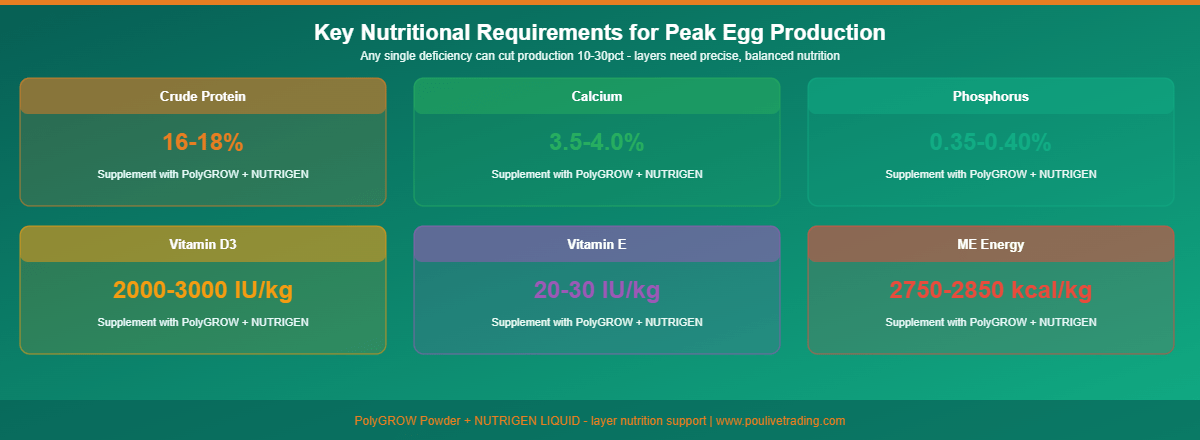
Layers need adequate dietary energy for maintenance, activity, and egg formation. Energy deficiency during hot weather (reduced feed intake) is one of the leading causes of summer egg production drops across Pakistan. Add fat supplements to maintain energy density during summer months.
Protein and Amino Acids
Each egg contains approximately 6.3 g of protein. Methionine is the first-limiting amino acid in layer diets — deficiency reduces both egg size and egg number. Ensure feed contains 0.38–0.42% digestible methionine per kilogram of feed.
Calcium and Phosphorus
Eggshell formation requires 2.0–2.2 g of calcium per egg. Peak layers need 4.0–4.5% dietary calcium. Deficiency causes soft-shelled eggs, floor eggs, and bone fractures. Phosphorus must be carefully balanced with calcium — excess phosphorus reduces shell quality.
Key Vitamins for Layers
- Vitamin D3: Essential for calcium absorption — deficiency causes shell-less eggs and rickets
- Vitamin E + Selenium: Antioxidant protection of the reproductive tract
- Vitamin K: Blood clotting and bone mineralisation
- B12 and Folic Acid: Red blood cell production and embryo viability in breeders
Management Factors That Affect Egg Production
Lighting Programme
Light stimulates the hypothalamus-pituitary-ovarian axis to trigger ovulation. The golden rule: never decrease day length during the laying period.
- Grow pullets on 8–10 hours of light until 17–18 weeks of age
- Stimulate at 18 weeks by increasing to 13 hours — add 1 hour per week thereafter
- Maintain 16 hours of light at peak production throughout lay
- Use minimum 10–20 lux at bird level with uniform illumination across the house
Water Supply
Eggs are 74% water. Clean, fresh water must be available continuously. Layers consume 1.6–1.8× as much water as feed by weight. Even 2–4 hours of water restriction in hot weather can cause a dramatic production drop that takes weeks to recover.
Feed Access
Ensure minimum 10 cm of trough space per bird. Distribute feed within 4 hours of lights-on. Competitive feeding causes stress, uneven body condition, and poor uniformity — all of which suppress production.
Health Threats That Suppress Egg Production
- Newcastle Disease: Can cause a 50–100% production drop within 24 hours
- Infectious Bronchitis: Egg drop with concurrent poor shell and albumen quality — can take 4–6 weeks to recover
- Egg Drop Syndrome 1976 (EDS-76): Causes pale, soft-shelled eggs with production drop — prevent with vaccination
- Infectious Coryza: Facial swelling and production suppression of 10–40%
- Mycoplasma gallisepticum (CRD): Chronic production suppression of 10–20% throughout lay
- Fatty Liver Haemorrhagic Syndrome (FLHS): Excess energy leading to liver rupture and sudden death in high-producing layers
Supplementation Programme for Peak Production
- Use NUTRIGEN LIQUID (Poulive Trading) during heat stress, post-vaccination, and after disease recovery
- Add PolyGROW Powder at 75 g/50 kg feed to bridge nutritional gaps in base feed
- Use AZ-TOXIMIX year-round to prevent mycotoxin-induced production losses
- Supplement extra calcium (oyster shell or limestone grit) on a free-choice basis for high producers
Key Performance Metrics to Track
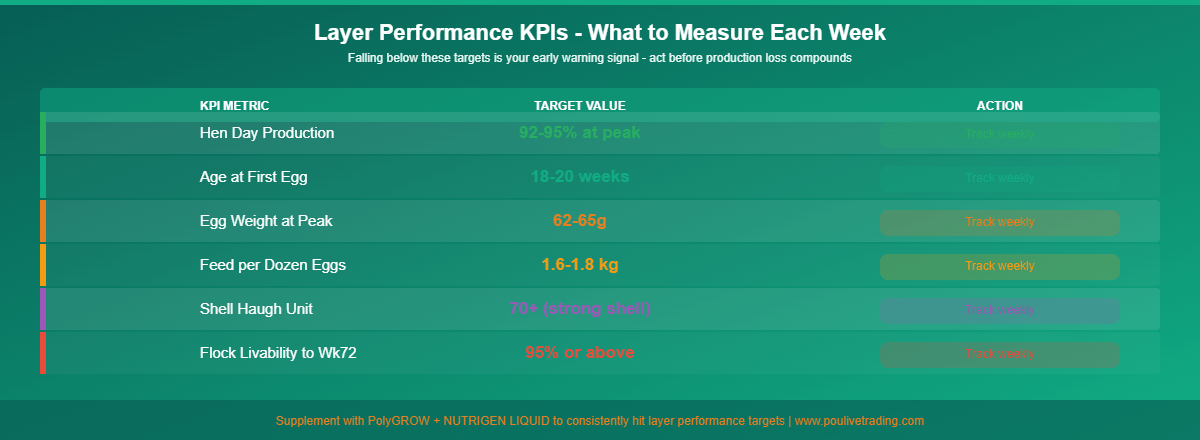
- Hen-Day Production (HDP): Eggs per hen alive per day × 100 — most accurate daily measure
- Feed Conversion for Eggs: Target below 2.1 kg feed per dozen eggs
- Average Egg Weight: Target 62–65 g at peak production
- Daily Mortality Rate: Target below 0.02% per day during laying
- Shell Quality: Track percentage of cracked/downgraded eggs — target below 2%
Need expert advice on your layer flock’s production problem? Call Poulive Trading’s veterinary team at +92 300 4776312.
Disclaimer: Production targets are based on commercial hybrid layer genetics. Actual performance varies with genetics, climate, housing, and management. Consult a poultry production specialist for farm-specific advice.