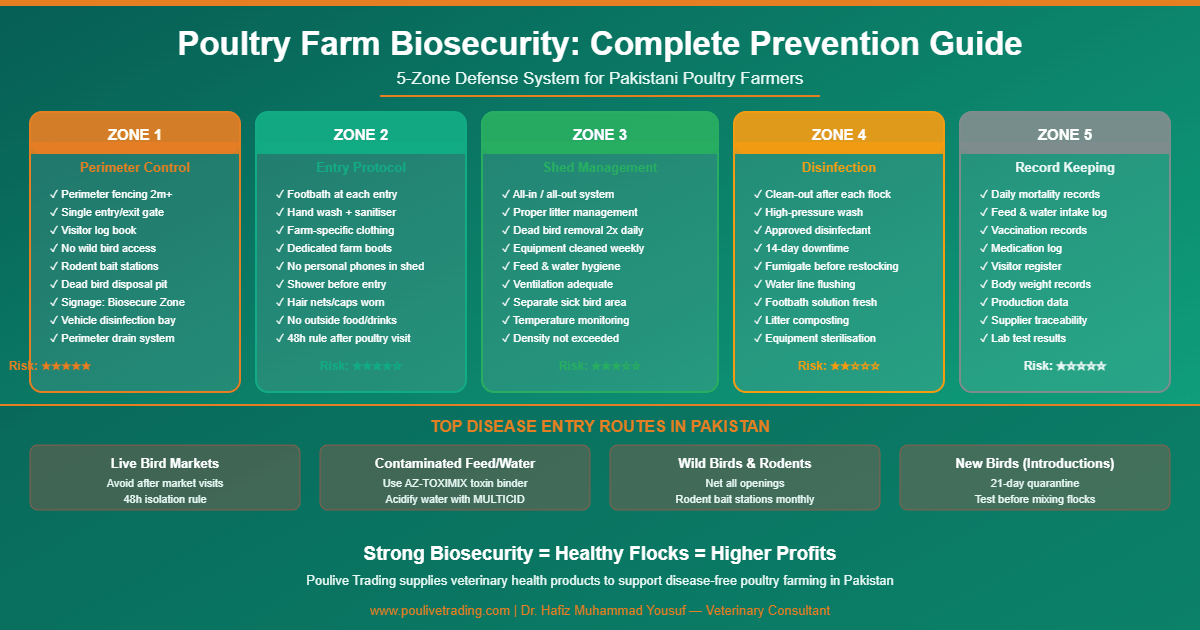
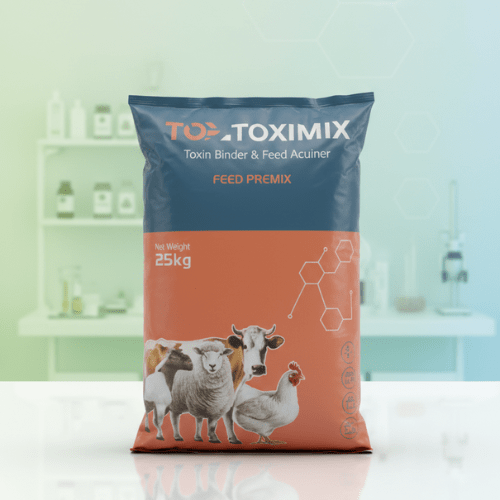
Featured Product: AZ-TOXIMIX
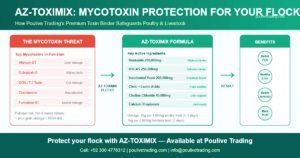
Contaminated feed is one of the leading entry points for disease on Pakistani poultry farms. AZ-TOXIMIX neutralises mycotoxins in feed, protecting the gut lining and immune system so your biosecurity programme works at its full potential.
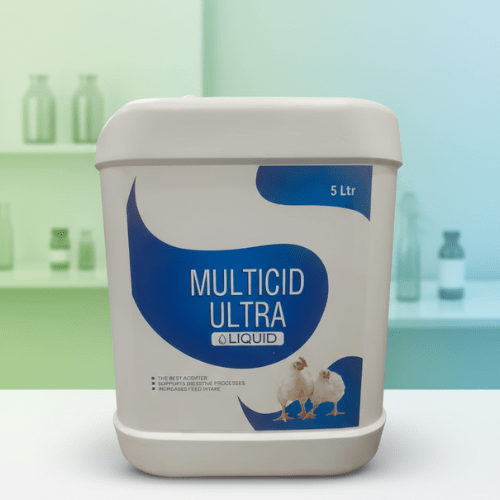
Featured Product: MULTICID ULTRA LIQUID
MULTICID ULTRA LIQUID acidifies drinking water, kills waterborne pathogens (Salmonella, E. coli, Campylobacter) and reduces biofilm in water lines — a critical tool in any farm biosecurity programme. Use at 0.5–1 ml per litre of drinking water.
Of all the investments a Pakistani poultry farmer can make — vaccines, medicines, feed additives, equipment upgrades — none delivers a higher return than a robust biosecurity programme. Biosecurity means preventing pathogens from entering your farm, and if they do enter, containing them before they spread. In a country where Newcastle Disease, Gumboro, Avian Influenza, and dozens of other pathogens circulate freely, biosecurity is not optional — it is survival.
At Poulive Trading, we partner with farmers not just through veterinary medicines but through education. This comprehensive guide covers every layer of biosecurity your farm must implement to operate safely and profitably in Pakistan.
The Three Pillars of Poultry Biosecurity
- Structural Biosecurity: Physical barriers — fencing, footbaths, controlled entry points, rodent-proof buildings, signage
- Operational Biosecurity: Standard Operating Procedures (SOPs) — what people do and how they consistently do it
- Conceptual Biosecurity: The mindset — every person on the farm understanding why biosecurity matters and following protocols without shortcuts
Farm Zoning and Access Control
Divide your farm into clearly defined, enforced zones:
- Clean Zone (inside houses): Where birds live — absolute minimum access, maximum protection
- Buffer Zone (around houses): Service areas, feed storage, medication rooms
- Transition Zone: Vehicle wash, personnel changing and showering facilities
- Dirty Zone (outside farm boundary): Where visitors, vehicles, and suppliers operate
The golden rule: all movement must flow from clean to dirty — never from dirty to clean. Violating this principle is how most disease outbreaks start.
Personnel Biosecurity
- All farm workers must shower in before entering the clean zone and change all clothing and footwear
- Dedicated farm footwear that never leaves the farm boundary
- No workers should own backyard poultry — or visit any other poultry farm within 24–48 hours
- Visitors (feed reps, medicine suppliers, buyers): access to buffer zone only — strict logbook record
- Anyone visiting a sick farm or live bird market: 48-hour stand-down before returning to your farm
- The farm manager should visit houses in age order (youngest birds first) to avoid transferring pathogens from older to younger flocks
All-In / All-Out Management
The single most impactful biosecurity practice is all-in/all-out management — placing all birds of the same age into a house on the same day, and removing them all on the same day before cleanout and restocking. This breaks the cycle of pathogen carryover between flocks. Never add birds to a house that already contains older birds.
Cleaning and Disinfection Protocol Between Flocks
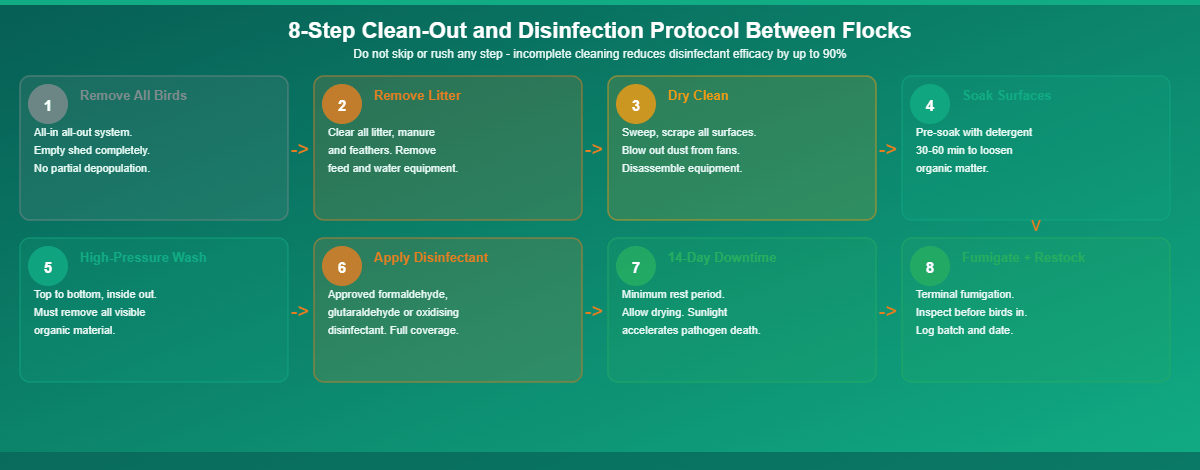
- Dry cleanout: Remove all litter, dead birds, and feed residues — dispose of correctly off-farm
- Dry brushing: Remove dust and organic material from walls, ceilings, and equipment surfaces
- Soaking: Apply detergent or foam to all surfaces and leave 30–60 minutes to break down organic matter
- High-pressure wash: Thoroughly wash all surfaces top to bottom
- Drying: Allow 24–48 hours complete drying before disinfection
- Disinfection: Apply approved disinfectant at correct dilution covering all surfaces
- Fumigation (recommended): Formalin fumigation of sealed house for 12 hours
- Downtime: Minimum 10–14 days between cleanout completion and restocking
Vehicle and Equipment Biosecurity
- All vehicles entering the farm must be washed and disinfected at the vehicle spray bay
- Dedicated farm-only vehicles for internal transport — never leave the property
- Never allow catch crews, live haul trucks, or dead bird collection vehicles past the transition zone
- All equipment entering the clean zone: wash, disinfect, and dry completely
- Never borrow or lend equipment between farms — this is one of the most common ways disease spreads
Water System Biosecurity
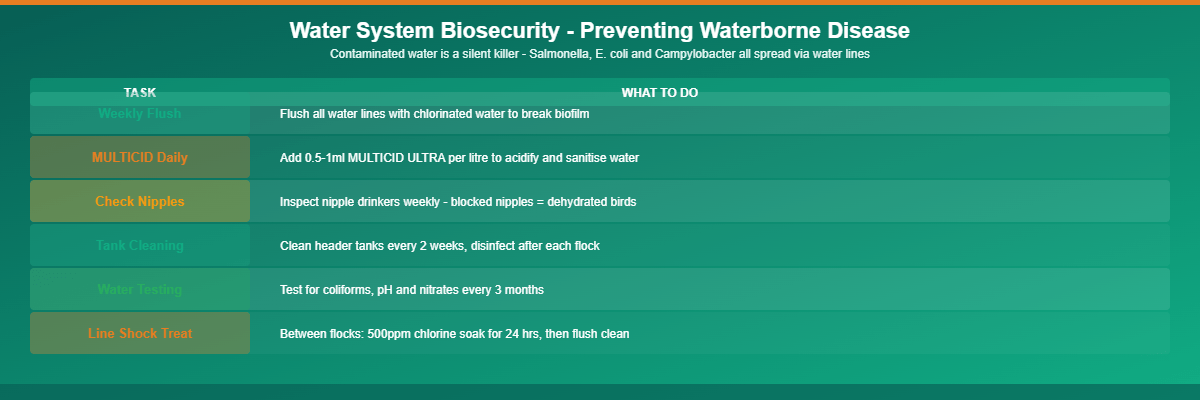
- Test water source for bacterial contamination at least twice yearly
- Flush and disinfect all water lines between flocks using hydrogen peroxide or chlorine products
- Check nipple drinkers daily for proper flow — blocked nipples cause dehydration; leaking nipples cause wet litter
- Maintain water pH between 6.0–6.8 and free chlorine at 1–3 ppm at the drinker end
Rodent and Pest Control
Rodents are major vectors of Salmonella, Leptospira, and other pathogens. Litter beetles transmit Marek’s disease, Salmonella, and Gumboro virus. An effective Integrated Pest Management (IPM) programme includes:
- Permanent bait stations at all entry points and around houses — check and refill monthly
- Seal all gaps and holes in walls and floors ≥6 mm in diameter
- Manage wet litter and feed spillage that attracts rodents
- Control litter beetle (Alphitobius diaperinus) with appropriate insecticide treatments between flocks
- Manage standing water around farm buildings to eliminate fly breeding sites
Dead Bird Disposal
- Collect dead birds daily — never leave them in the house overnight
- Use dedicated dead bird carts — never the same cart used for feed or live birds
- Approved disposal: deep burial (≥2 m), on-farm composting, incineration, or rendering plant
- Never transport dead birds from one farm to another
- Record daily mortality for each house — sudden increases are your earliest disease warning signal
Poulive Trading offers veterinary consultation on farm-level biosecurity planning and disease prevention. Contact us: info@poulivetrading.com | +92 300 4776312
Disclaimer: Biosecurity requirements vary by farm type, size, and local regulations. Consult your regional Livestock and Dairy Development Department for regulatory guidance specific to your area.